
You've tried meditating.
Maybe you followed the instructions: sit still, watch your breath, gently return when your mind wanders. Simple enough — and yet something felt off. Anxious instead of calm. Restless instead of peaceful. Numb instead of present.
If that sounds familiar, you didn't fail at meditation. Your nervous system was just doing its job.
Your body has a built-in alarm system
Without you choosing it, your nervous system is constantly scanning for danger. When it detects a threat — real or not — it shifts into one of two survival modes:
Fight-or-flight: Racing thoughts, restlessness, the urge to escape. In meditation, this looks like an inability to sit still or a mind that won't stop spinning.
Freeze: Shutdown, numbness, dissociation. In meditation, this looks like zoning out, sudden fatigue, or feeling strangely far away from yourself.
This is something most meditation teachers don't mention: traditional instructions assume you're already calm when you sit down. For many people — especially those carrying chronic stress or past trauma — that's simply not the case.
Telling a dysregulated nervous system to "just observe the breath" is a bit like telling someone to swim laps before they've learned to float.
Why the breath isn't always a safe anchor
For some people, focusing on the breath doesn't bring calm — it brings panic. That's not weakness or imagination. If your body learned to survive by holding its breath, breathing shallowly under pressure, or going still during frightening experiences, then the breath carries memory. Bringing attention there can activate the very stress response you're trying to settle.
This is more common than you'd think. And it's rarely talked about.

Last weekend Ryan and I raced in a skimo event — ski mountaineering. Racing isn't really my thing, but our friend was hosting and I wanted to show up for him.
The range of sensations running through my body that morning was vast. But underneath all of it, I recognized something familiar: fear of competing, fear of failing. And because I could name it, I had a choice. I chose to focus on my rhythm and trust that I could finish.
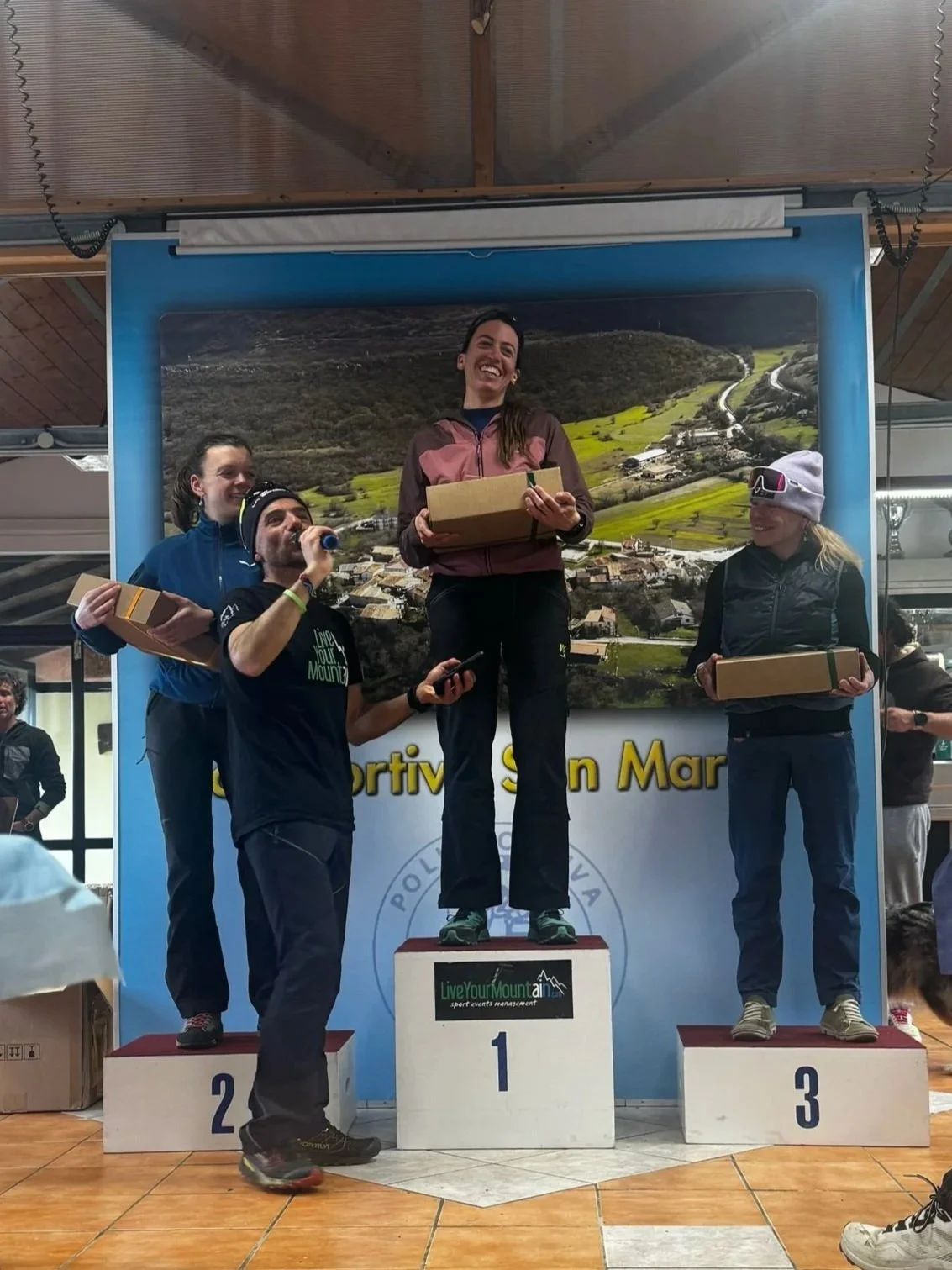
Because I kept going — nervous stomach and all — I got to prove something to myself. That I'm capable of doing hard things.
And sometimes, showing up anyway comes with a little reward. 🥉
Because I kept going — nervous stomach and all — I got to prove something to myself. That I'm capable of doing hard things.
And sometimes, showing up anyway comes with a little reward. 🥉
A different way in: sensing instead of observing
Rather than watching your experience from a distance, what if you could actually inhabit it?
Instead of observing the breath, you gently turn attention toward direct physical sensation:
The weight of your body against the chair
The temperature of your skin
A subtle pulse, or the texture of a single feeling
This kind of grounded, body-based attention signals safety to your nervous system — and from that place of safety, meditation begins to work the way it was always meant to.
What becomes possible
When your nervous system feels safe, everything shifts. Anxiety quiets. Presence becomes natural rather than forced. Meditation stops feeling like something you have to push through — and starts feeling like somewhere you actually want to be.
This isn't about adding more hours of practice. It's about building a foundation: understanding your own nervous system.
And it's worth knowing: sitting still isn't the only door in.
For some nervous systems, stillness itself is the obstacle. If fight-or-flight energy is running high, trying to sit quietly can feel like pressing down on a spring — the body just pushes back harder.
That's why practices like walking meditation, qigong, tai chi, and yoga can be genuinely better starting points for certain people. Movement gives the nervous system somewhere to put its energy. It processes activation rather than suppressing it — and can bring you into the same quality of presence that seated practice aims for, just through a different route.
There's no hierarchy here. The best meditation for you is the one your nervous system can actually receive.
Ready to go deeper?
If any of this resonates, this is exactly the work we explore together in my Somatic Experiencing® and Somatic Embodiment Coaching sessions.
Through this work, you'll develop a real, embodied understanding of your own nervous system — not just as a concept, but as something you can actually feel and work with. You'll gain awareness of what's genuinely happening inside you, and build the capacity to regulate it from the inside out.
I'm currently completing hours for my three-year Somatic Experiencing training, which means I'm offering deeply discounted sessions right now — a rare opportunity to access this work at a fraction of the usual cost.
If you're curious whether this could be the missing piece for you, I'd love to connect. Book a free clarity call and we'll explore it together.
These are intense times — collectively and personally. Many of us are carrying more than we let on. Whatever you're navigating right now, I hope this newsletter offered a moment of recognition and a little light.
Sending you so much love.
Hanni,
Certified Advanced Rolfer®, Somatic Coach, Somatic Experiencing® Practioner in training
…And one more thing worth celebrating 🎉
Another incredible woman has just signed up for the October retreat — and I am so thrilled to welcome her.
That leaves just 3 spots remaining.
This is a small, intimate gathering by design. When it's full, it's full.
If something in you has been quietly wondering whether this retreat is for you — that wondering is worth listening to.

Honestly, this little guy might have been the most prepared one at the race — and he reminded me that sometimes the best approach to something intimidating is to just show up, look the part, and trust the ride.
